
AAV ELISA Kits: Reliable Quantification Tools for Adeno-Associated Virus Research
Introduction
Adeno-associated virus (AAV) has become one of the most widely studied viral vectors in modern molecular biology and biotechnology. Because of its relatively small genome, stable capsid structure, and efficient delivery capability, AAV is frequently used in gene delivery research, viral vector development, and molecular biology studies.
To support these investigations, laboratories often rely on AAV ELISA Kits, which provide sensitive immunoassay-based quantification of AAV viral capsids or antibodies against AAV. These kits enable researchers to measure viral particle concentration and evaluate vector production efficiency.
Scientific background on viral vector systems and molecular virology can be explored through academic and government research resources such as:
-
National Institutes of Health — https://www.nih.gov/
-
National Center for Biotechnology Information — https://www.ncbi.nlm.nih.gov/
-
National Human Genome Research Institute — https://www.genome.gov/
-
National Institute of General Medical Sciences — https://www.nigms.nih.gov/
Using enzyme-linked immunosorbent assay (ELISA) technology, AAV ELISA kits provide a practical and reproducible method for quantifying viral particles in biological samples and viral vector preparations.
Understanding Adeno-Associated Virus (AAV)
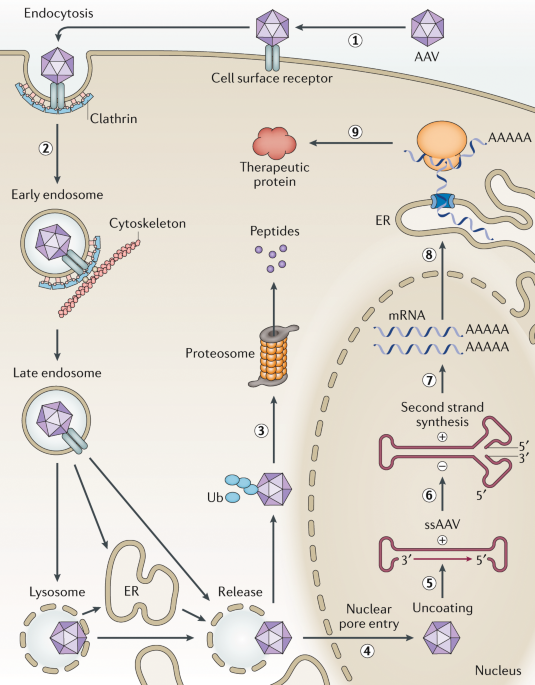
AAV belongs to the Parvoviridae family and is one of the smallest single-stranded DNA viruses known in molecular virology. Multiple AAV serotypes have been identified, each exhibiting distinct tissue tropisms and biological properties.
These viruses contain a capsid composed of three structural proteins:
-
VP1
-
VP2
-
VP3
These proteins assemble into the viral capsid that protects the viral genome and mediates cellular entry.
Detailed information on viral genetics and DNA viruses can be found through academic educational resources such as:
-
University of Utah Genetic Science Learning Center — https://learn.genetics.utah.edu/
-
Harvard University Department of Molecular and Cellular Biology — https://mcb.harvard.edu/
-
Stanford University Department of Genetics — https://med.stanford.edu/genetics.html
AAV vectors have become widely used in molecular biology research because they allow stable delivery of genetic material into cells, enabling investigations of gene regulation, protein expression, and cellular signaling.
What Are AAV ELISA Kits?
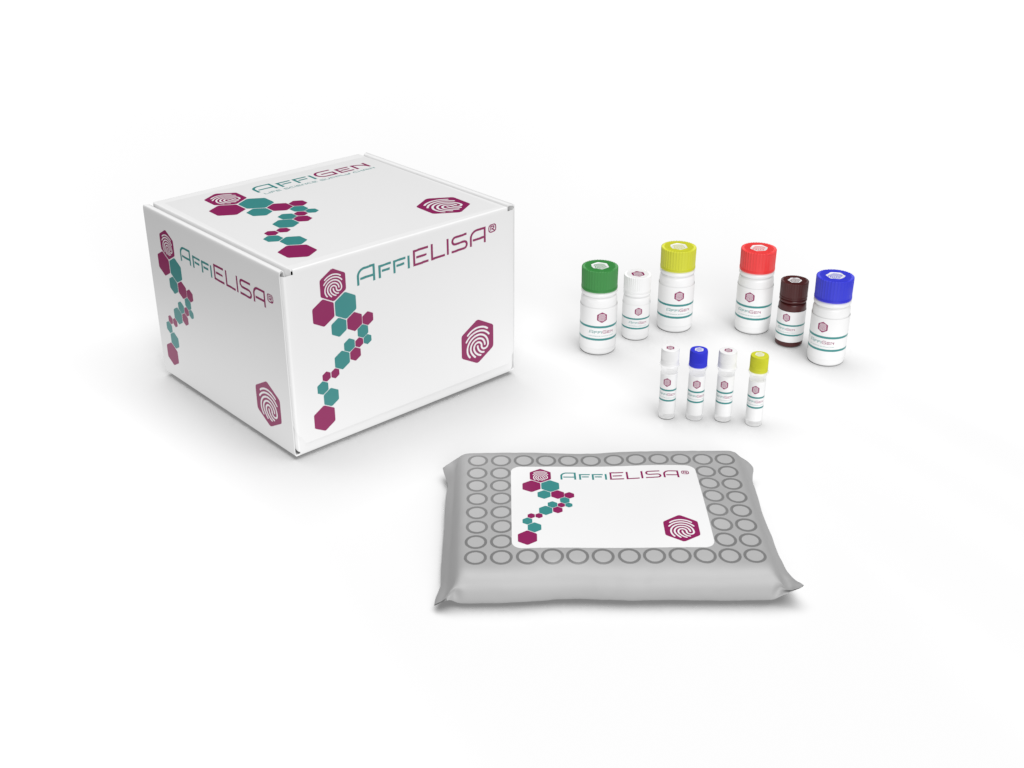
AAV ELISA kits are laboratory immunoassays designed to detect or quantify AAV capsid proteins or antibodies against AAV using enzyme-linked immunosorbent assay technology.
Most kits include:
-
pre-coated microplates
-
capture antibodies specific for AAV capsid proteins
-
detection antibodies
-
enzyme conjugates
-
chromogenic substrates
-
standards for calibration
These reagents allow researchers to perform quantitative or qualitative detection of AAV viral particles in samples such as cell culture supernatants, serum, or viral vector preparations.
ELISA kits are typically supplied with optimized reagents and protocols to ensure reliable detection of viral antigens.
Principle of the AAV ELISA Assay
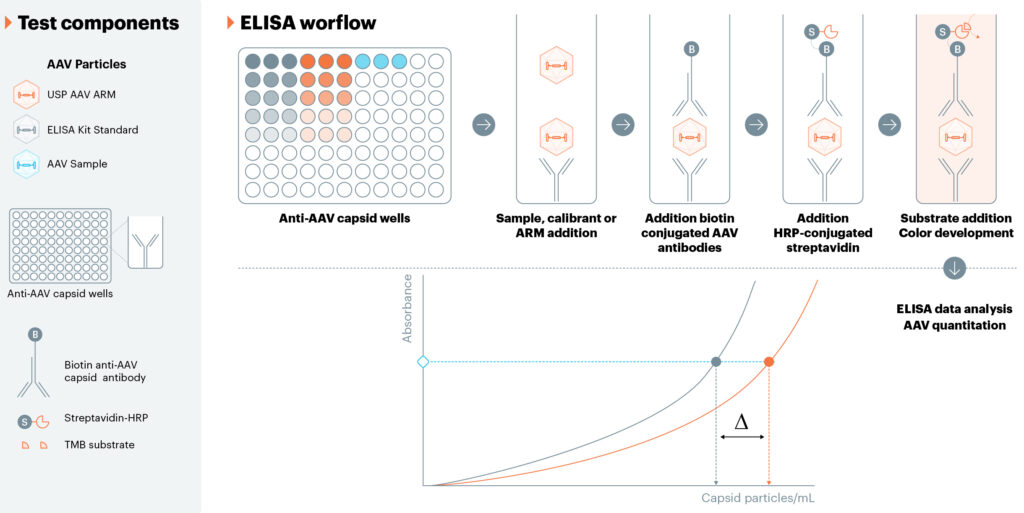
Most AAV ELISA kits operate using a sandwich ELISA format, which relies on two antibodies recognizing different epitopes on the viral capsid protein.
Typical assay workflow:
-
Capture antibodies immobilized on the microplate bind AAV capsid proteins present in the sample.
-
A second antibody binds the captured capsid antigen.
-
An enzyme-linked detection system produces a colorimetric signal.
-
Signal intensity correlates with the concentration of AAV particles.
This immunoassay format allows precise quantification of viral particles within a defined detection range.
Educational explanations of ELISA methodology are available through:
-
National Institute of Allergy and Infectious Diseases — https://www.niaid.nih.gov/
-
Centers for Disease Control laboratory science resources — https://www.cdc.gov/labs/
-
U.S. Food and Drug Administration research programs — https://www.fda.gov/science-research
The absorbance signal is typically measured at 450 nm using a microplate reader, allowing calculation of viral titers based on a standard curve.
Detection of Multiple AAV Serotypes
One of the key advantages of modern AAV ELISA kits is their ability to detect multiple viral serotypes.
Commonly studied AAV serotypes include:
-
AAV1
-
AAV2
-
AAV5
-
AAV6
-
AAV8
-
AAV9
Some ELISA systems are designed specifically for a single serotype, while others allow detection across multiple serotypes using cross-reactive antibodies.
Academic studies have demonstrated that capture ELISA systems can effectively quantify AAV capsid particles for different serotypes, enabling reliable viral vector characterization.
Biological Samples Compatible with AAV ELISA Kits
AAV ELISA assays are commonly used to analyze viral particles in several biological matrices.
Typical sample types include:
• viral vector production supernatants
• cell culture media
• purified viral preparations
• serum samples
• plasma samples
• research viral stocks
Because ELISA assays require relatively small sample volumes, they are well suited for routine viral vector monitoring during laboratory experiments.
Research Applications of AAV ELISA Kits
AAV ELISA assays are widely used in molecular biology laboratories studying viral vectors and gene delivery systems.
1. Viral Vector Quantification
AAV ELISA kits are frequently used to quantify capsid titers in viral vector production systems.
Reliable quantification is essential for evaluating viral vector preparation efficiency and ensuring consistent viral particle concentrations in experimental workflows.
Research describing viral vector characterization can be found at:
-
National Institutes of Health gene therapy resources
https://www.nih.gov/research-training -
National Center for Biotechnology Information viral vector publications
https://pubmed.ncbi.nlm.nih.gov/
2. Gene Delivery Research
AAV vectors are widely used as gene transfer tools in molecular biology and biotechnology research.
Because of their stable capsid and efficient transduction properties, AAV vectors are often evaluated using analytical methods such as:
-
ELISA
-
qPCR
-
digital PCR
-
electron microscopy
Combining these analytical approaches provides detailed insight into viral particle structure, genome packaging, and vector quality.
Educational information about viral gene delivery systems is available through:
-
National Human Genome Research Institute
https://www.genome.gov/ -
MIT Biology Department
https://biology.mit.edu/
3. Viral Capsid Characterization
Quantifying capsid proteins is essential for understanding viral particle composition and structural integrity.
The AAV capsid contains three structural proteins (VP1, VP2, VP3), which assemble to form the viral particle.
ELISA assays enable researchers to monitor capsid levels in viral preparations, supporting studies in:
-
viral assembly
-
vector stability
-
capsid engineering
-
viral particle purification
4. Antibody Screening Against AAV
Some ELISA assays are designed to detect antibodies that bind AAV capsids, allowing researchers to evaluate immune responses to viral vectors.
Studies comparing ELISA screening methods with neutralization assays have shown strong correlation between the two approaches when detecting antibodies targeting AAV serotypes.
Advantages of AAV ELISA Kits
Modern AAV ELISA systems provide several advantages that make them widely used in viral vector research.
High Sensitivity
Antibody-based detection allows measurement of low concentrations of viral capsids.
Quantitative Measurement
Standard curves enable precise calculation of viral particle concentration.
High Throughput
Microplate formats allow simultaneous analysis of multiple samples.
Reproducibility
Validated antibodies and optimized reagents support consistent assay performance.
Compatibility With Multiple Serotypes
Some kits detect several AAV serotypes within a single assay.
Typical Workflow of an AAV ELISA Experiment
A typical AAV ELISA assay follows these steps:
-
Preparation of standards and samples
-
Addition of samples to capture antibody-coated wells
-
Incubation with detection antibodies
-
Washing to remove unbound components
-
Addition of enzyme-linked reagents
-
Substrate reaction for color development
-
Measurement of absorbance using a microplate reader
-
Calculation of viral titer using a standard curve
Laboratory training materials describing ELISA workflows are available from:
-
NIH research training programs
https://www.nih.gov/research-training -
University of Wisconsin Biotechnology Center
https://www.biotech.wisc.edu/
Integration With Molecular Biology Techniques
In many research laboratories, AAV ELISA kits are used alongside other analytical methods to evaluate viral vectors.
Examples include:
• qPCR vector genome quantification
• transmission electron microscopy analysis
• SDS-PAGE capsid characterization
• flow cytometry analysis
• viral infectivity assays
Combining these analytical tools allows comprehensive characterization of AAV vector preparations and viral particle quality.
Conclusion
AAV ELISA Kits are essential tools for detecting and quantifying adeno-associated virus particles in molecular biology and biotechnology research.
By using antibody-based detection of viral capsid proteins, these immunoassays provide reliable measurement of AAV viral titers and capsid levels, supporting studies in viral vector development, gene delivery research, and viral particle characterization.
Thanks to their high sensitivity, reproducibility, and compatibility with multiple sample types, AAV ELISA assays remain widely used in laboratories investigating viral vectors and molecular virology.