
Traditional / TA Cloning Reagents: The Ultimate Guide to Efficient PCR Cloning and Molecular Biology Workflows
Introduction: The Enduring Role of Cloning in Modern Life Sciences
Molecular cloning is one of the most foundational and widely used techniques in biological research. From gene discovery to recombinant protein production, cloning technologies enable scientists to manipulate DNA with precision and reproducibility. Despite the emergence of advanced cloning systems, Traditional cloning and TA cloning remain indispensable due to their simplicity, reliability, and efficiency.
Traditional/TA Cloning Reagents, such as those available through Affigen.com, are designed to streamline DNA insertion workflows, particularly for PCR-amplified fragments. These reagents offer researchers a robust toolkit for cloning applications across genomics, biotechnology, microbiology, and cell biology.
To understand the molecular basis of cloning, explore foundational scientific resources:
- https://www.genome.gov/genetics-glossary/DNA
- https://www.ncbi.nlm.nih.gov/genbank/
- https://www.nature.com/scitable/topicpage/dna-cloning-and-recombinant-dna-technology-409/
- https://www.ncbi.nlm.nih.gov/books/NBK21134/
The Principles of Molecular Cloning
Molecular cloning involves the insertion of a DNA fragment into a vector, allowing its propagation in a host organism. This process relies on the natural ability of cells to replicate DNA, enabling researchers to generate multiple copies of a gene of interest.
Core components include:
- DNA insert (target sequence)
- Cloning vector (plasmid)
- Host organism (commonly E. coli)
- Enzymatic tools (ligases, polymerases, restriction enzymes)
Detailed explanations can be found at:
- https://www.hhmi.org/biointeractive/molecular-cloning
- https://www.nigms.nih.gov/education/fact-sheets/Pages/DNA-Technology.aspx
- https://www.ebi.ac.uk/training/online/
Traditional Cloning: A Proven and Precise Approach
Workflow Overview
Traditional cloning relies on restriction enzymes and DNA ligase to insert DNA fragments into plasmid vectors. The process involves:
- DNA digestion using restriction enzymes
- Generation of compatible sticky or blunt ends
- Ligation of insert into vector
- Transformation into host cells
- Selection and screening
This method remains highly valuable for:
- Directional cloning
- Construct design
- Multi-fragment assembly
Learn more:
TA Cloning: A Fast and Efficient PCR Cloning Strategy
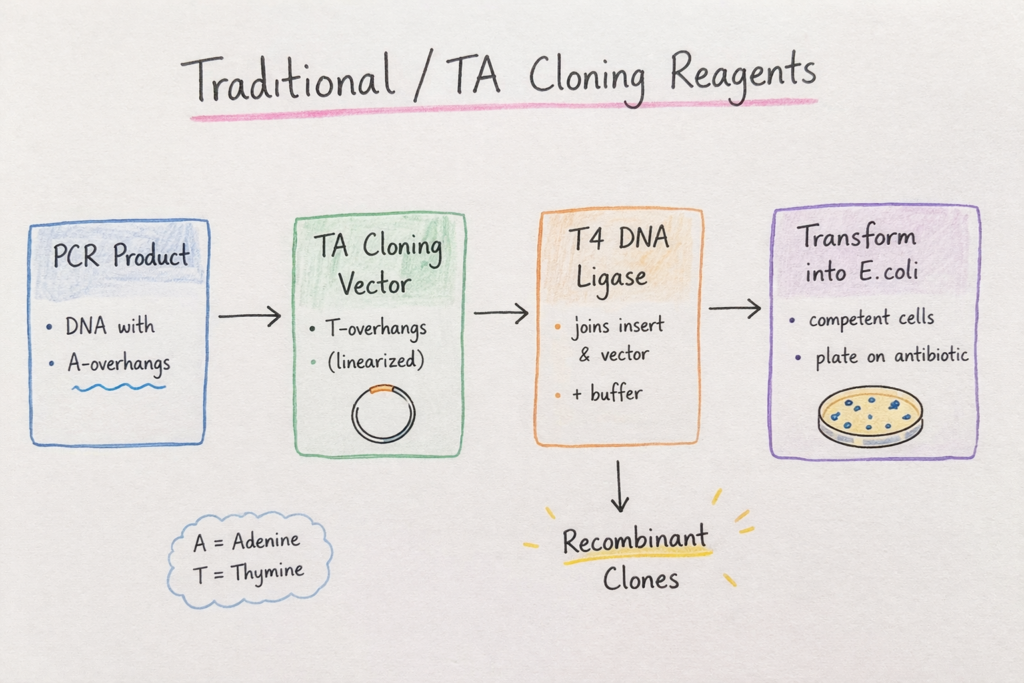
TA cloning is a specialized technique optimized for cloning PCR products. It exploits the biochemical activity of Taq DNA polymerase, which adds a single adenine (A) overhang to PCR products.
Mechanism
- PCR products carry 3′ A overhangs
- Vectors are pre-linearized with 3′ T overhangs
- Insert and vector anneal efficiently
- Ligation occurs rapidly without restriction digestion
This eliminates multiple steps, significantly accelerating cloning workflows.
Further reading:
- https://www.ncbi.nlm.nih.gov/pmc/articles/PMC4350901/
- https://www.genome.gov/about-genomics/fact-sheets/Cloning-Fact-Sheet
- https://www.ncbi.nlm.nih.gov/pmc/articles/PMC5665511/
Why Choose Affigen Traditional / TA Cloning Reagents?
Affigen.com offers a curated selection of cloning reagents designed for high efficiency, reproducibility, and ease of use.
Key Advantages
🔹 Optimized Performance
Affigen cloning systems are designed to maximize ligation efficiency and transformation success rates.
🔹 Time-Saving Workflows
TA cloning reagents reduce protocol complexity, enabling faster experimental turnaround.
🔹 High Compatibility
Compatible with a wide range of PCR products and vectors.
🔹 Reproducibility
Carefully validated components ensure consistent experimental outcomes.

Product Spotlight: Affigen TA Cloning Systems
Affigen’s TA cloning solutions are tailored for researchers seeking:
- High-efficiency cloning of PCR products
- Minimal hands-on time
- Reliable transformation results
- Flexible downstream applications
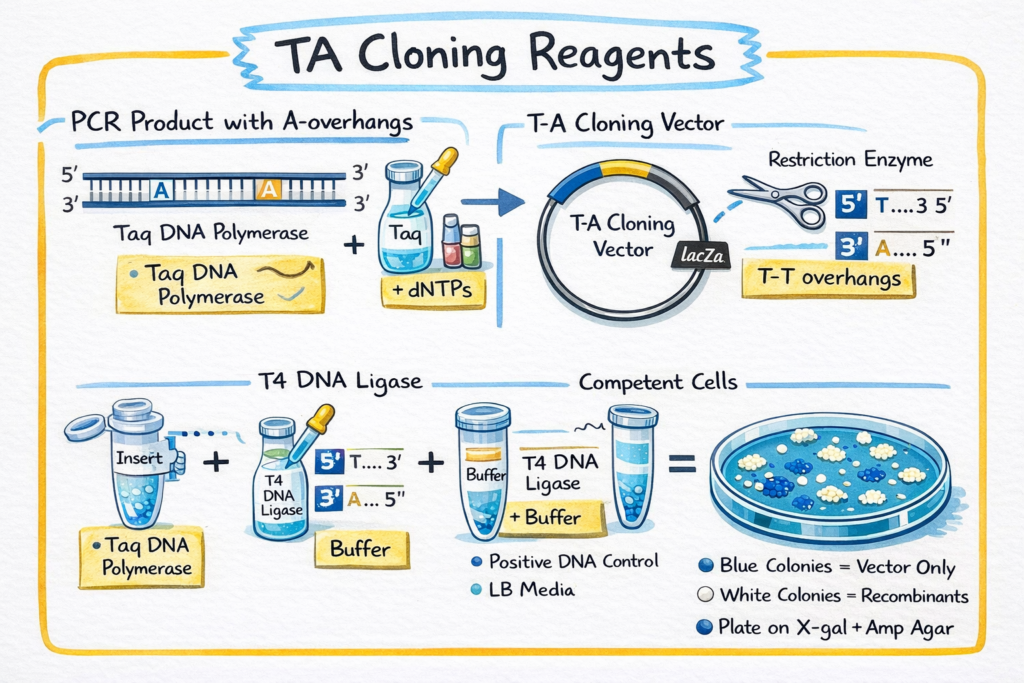
Typical Kit Components
- Linearized T-vector with optimized overhangs
- DNA ligase or topoisomerase system
- Competent cells (high transformation efficiency)
- Reaction buffers and controls
These components are engineered for seamless integration into standard molecular biology workflows.
Applications of Traditional and TA Cloning
🧬 Gene Cloning and Functional Analysis
Cloning enables isolation and characterization of genes for functional studies.
🧪 Recombinant Protein Expression
Cloned genes can be expressed in bacterial or eukaryotic systems.
🧫 PCR Product Cloning
TA cloning is ideal for direct insertion of amplified DNA fragments.
🧬 Vector Construction
Used to build plasmids for gene expression, mutagenesis, or reporter assays.
Explore applications:
- https://www.cdc.gov/genomics/
- https://www.niaid.nih.gov/research
- https://www.usda.gov/topics/biotechnology
Comparison: Traditional vs TA Cloning
| Feature | Traditional Cloning | TA Cloning |
|---|---|---|
| Restriction Enzymes | Required | Not required |
| Speed | Moderate | Fast |
| Complexity | Higher | Lower |
| Efficiency | High | Very high |
| PCR Compatibility | Limited | Excellent |
Best Practices for Using TA Cloning Reagents
To achieve optimal results:
- Use Taq polymerase for PCR amplification
- Avoid proofreading polymerases (no A-overhangs)
- Purify PCR products before cloning
- Optimize insert-to-vector ratio
- Maintain sterile conditions
Protocols:
Troubleshooting Common Issues
Low Cloning Efficiency
- Poor PCR quality
- Incorrect ligation ratio
- Degraded vector
No Colonies
- Inefficient competent cells
- Ligation failure
High Background
- Vector self-ligation
- Contamination
Integration with PCR and Downstream Applications
TA cloning works seamlessly with PCR-based workflows, including:
- qPCR validation
- Sequencing
- Mutagenesis
Affigen products can be combined with:
- qPCR Master Mixes
- DNA extraction kits
- Competent cells
Internal Linking Strategy (Affigen / SEO Boost)
- Explore TA Cloning Kits at Affigen.com
- Discover competent cells for cloning
- Browse DNA extraction solutions
- Check PCR reagents and master mixes
Scientific Relevance and Future Perspectives
Despite advances in synthetic biology and seamless cloning, Traditional and TA cloning remain widely used due to:
- Accessibility
- Cost-effectiveness
- Proven reliability
Emerging applications continue to rely on these foundational techniques.
Conclusion
Traditional and TA Cloning Reagents remain essential tools in molecular biology, offering researchers a balance of simplicity, efficiency, and reliability. With optimized systems available through Affigen.com, laboratories can achieve consistent and high-quality cloning results across a wide range of applications.