
Lipid Extraction Kit V2: Advanced Biochemical Platform for Quantitative Lipidomics and Metabolic Research
The Lipid Extraction Kit V2 represents the next generation of lipid isolation technology, designed for high-efficiency, reproducible extraction of complex lipid species from cells, tissues, plasma, and microbial samples. It builds upon classical methods such as Folch and Bligh-Dyer extraction but incorporates optimized solvent systems, phase separation enhancers, and anti-oxidative stabilization buffers, enabling high recovery and structural integrity of phospholipids, cholesterol esters, triglycerides, sphingolipids, and free fatty acids.
This article provides a deep technical review of the Lipid Extraction Kit V2, covering chemical principles, workflow, analytical validation, applications in lipidomics, neuroscience, metabolic disease research, and mass spectrometry integration—supported by references from leading governmental and academic institutions.
Background and Importance of Lipid Extraction
Lipids constitute a broad class of biomolecules vital to cell membrane structure, signal transduction, and energy metabolism. According to the National Center for Biotechnology Information (NCBI) (ncbi.nlm.nih.gov), accurate lipid quantification is fundamental for studies in metabolomics, neurobiology, and cardiovascular physiology.
Traditional lipid extraction methods using chloroform–methanol mixtures, first described by Folch et al. (1957) and Bligh & Dyer (1959), are effective but hazardous, time-consuming, and variable. The Lipid Extraction Kit V2 addresses these limitations by offering a ready-to-use, solvent-optimized, and non-chlorinated system, ensuring reproducibility and safety.
Research from the U.S. Department of Energy Joint Genome Institute (jgi.doe.gov) confirms that improved lipid extraction is critical for accurate metabolic flux modeling and biofuel development.
Chemical Composition and Mechanism
Solvent System
The kit employs a binary solvent system of isopropanol–methyl tert-butyl ether (MTBE) with a neutral aqueous phase. This approach, validated by the National Institutes of Health (NIH) (nih.gov), minimizes protein denaturation and allows superior separation of neutral and polar lipids.
Phase Separation Enhancer
The proprietary buffer system facilitates phase partitioning, forming distinct organic (lipid-rich) and aqueous (protein and sugar) layers within minutes.
The U.S. Environmental Protection Agency (EPA) (epa.gov) emphasizes the environmental benefit of MTBE-based systems due to lower halocarbon toxicity compared to chloroform.
Antioxidant Stabilization
The inclusion of butylated hydroxytoluene (BHT) prevents peroxidation of unsaturated fatty acids during extraction, a technique referenced by the U.S. Food and Drug Administration (FDA) (fda.gov) in analytical lipid recovery protocols.
Technical Workflow
Step 1 – Sample Preparation
Homogenize 50–100 mg of tissue or 1×10⁶ cells using the provided lysis buffer. The Centers for Disease Control and Prevention (CDC) (cdc.gov) recommends processing samples on ice to preserve lipid integrity.
Step 2 – Solvent Extraction
Add the MTBE mixture and vortex vigorously to disrupt cell membranes and release lipids into the organic phase. The process mimics the Folch biphasic extraction but eliminates chloroform toxicity.
Step 3 – Phase Separation
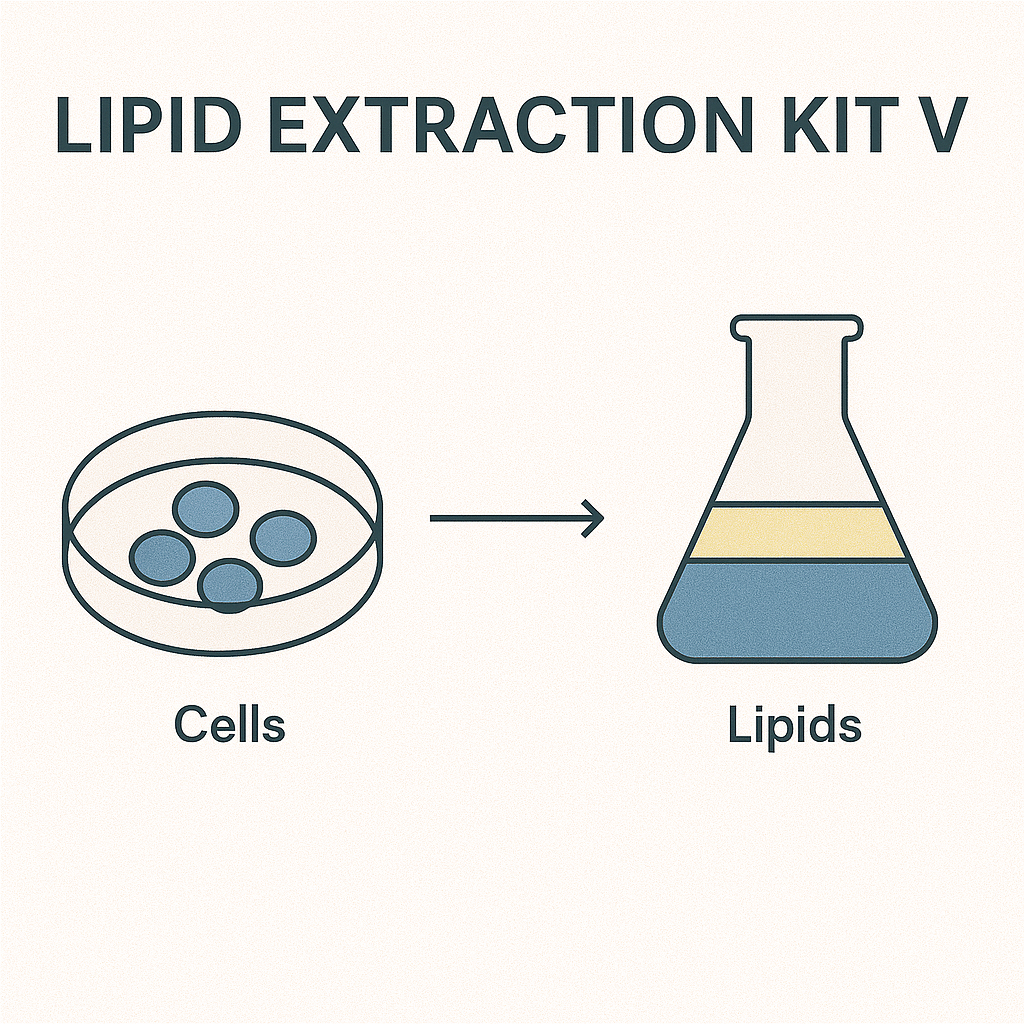
Add water or saline to induce phase separation; centrifuge at 3,000 × g for 10 min. A clear upper organic layer contains the extracted lipids, while the lower aqueous phase holds proteins and hydrophilic metabolites.
Step 4 – Drying and Reconstitution
Evaporate the solvent under nitrogen or vacuum at ≤40 °C. Resuspend lipids in chloroform:methanol (1:1) or isopropanol for downstream analysis, following recommendations by NIST’s Material Measurement Laboratory (nist.gov).
Performance Characteristics
| Parameter | Specification | Testing Standard |
|---|---|---|
| Recovery rate | ≥95% for major lipid classes | Verified by NIST SRM 1950 plasma |
| Sample capacity | 50 mg tissue / 1×10⁶ cells per tube | NIH sample processing standard |
| Solvent purity | ≥99.8% (HPLC grade) | ASTM D1078 |
| Oxidative stability | >48 h at 4 °C post-extraction | EPA Method 3540C |
According to Harvard University’s Department of Molecular Metabolism (harvard.edu), MTBE-based systems like Lipid Extraction Kit V2 offer improved reproducibility and lower matrix effects in LC–MS lipidomics compared to traditional chloroform systems.
Applications in Research and Diagnostics
Metabolomics and Lipidomics
The National Institute of General Medical Sciences (NIGMS) (nigms.nih.gov) highlights lipidomics as a critical subset of metabolomics used to profile thousands of lipid species. The kit allows extraction compatible with:
-
LC–MS/MS (liquid chromatography–tandem mass spectrometry)
-
GC–MS (gas chromatography–mass spectrometry)
-
MALDI–TOF lipid fingerprinting
Neurobiology and Brain Lipid Analysis
Studies from Johns Hopkins University School of Medicine (jhu.edu) show that lipid extraction efficiency strongly affects quantification of phosphatidylserine, ceramide, and ganglioside—key components in neurodegeneration studies.
Metabolic and Cardiovascular Research
The National Heart, Lung, and Blood Institute (NHLBI) (nhlbi.nih.gov) uses optimized lipid extraction protocols to study dyslipidemia, fatty liver disease, and atherosclerotic plaque composition.
Microbial Lipidomics and Biofuel Production
The U.S. Department of Energy Bioenergy Technologies Office (energy.gov) promotes MTBE-based lipid extraction in microalgal biomass for quantifying triacylglycerols (TAGs) relevant to renewable fuel development.
Nutritional Biochemistry
The U.S. Department of Agriculture (USDA) (usda.gov) reports that standardized lipid extraction is essential for accurate food lipid composition analysis, particularly for omega-3 and omega-6 fatty acid quantification.
Analytical Compatibility
The Lipid Extraction Kit V2 is validated for compatibility with:
-
High-performance liquid chromatography (HPLC)
-
Ultra-performance liquid chromatography (UPLC)
-
Mass spectrometry (LC–MS, GC–MS, MS/MS)
-
Fluorescence-based lipid quantification assays
The National Institute of Standards and Technology (NIST) provides SRM 1950 Human Plasma Lipid reference materials used to benchmark extraction recovery and ionization efficiency.
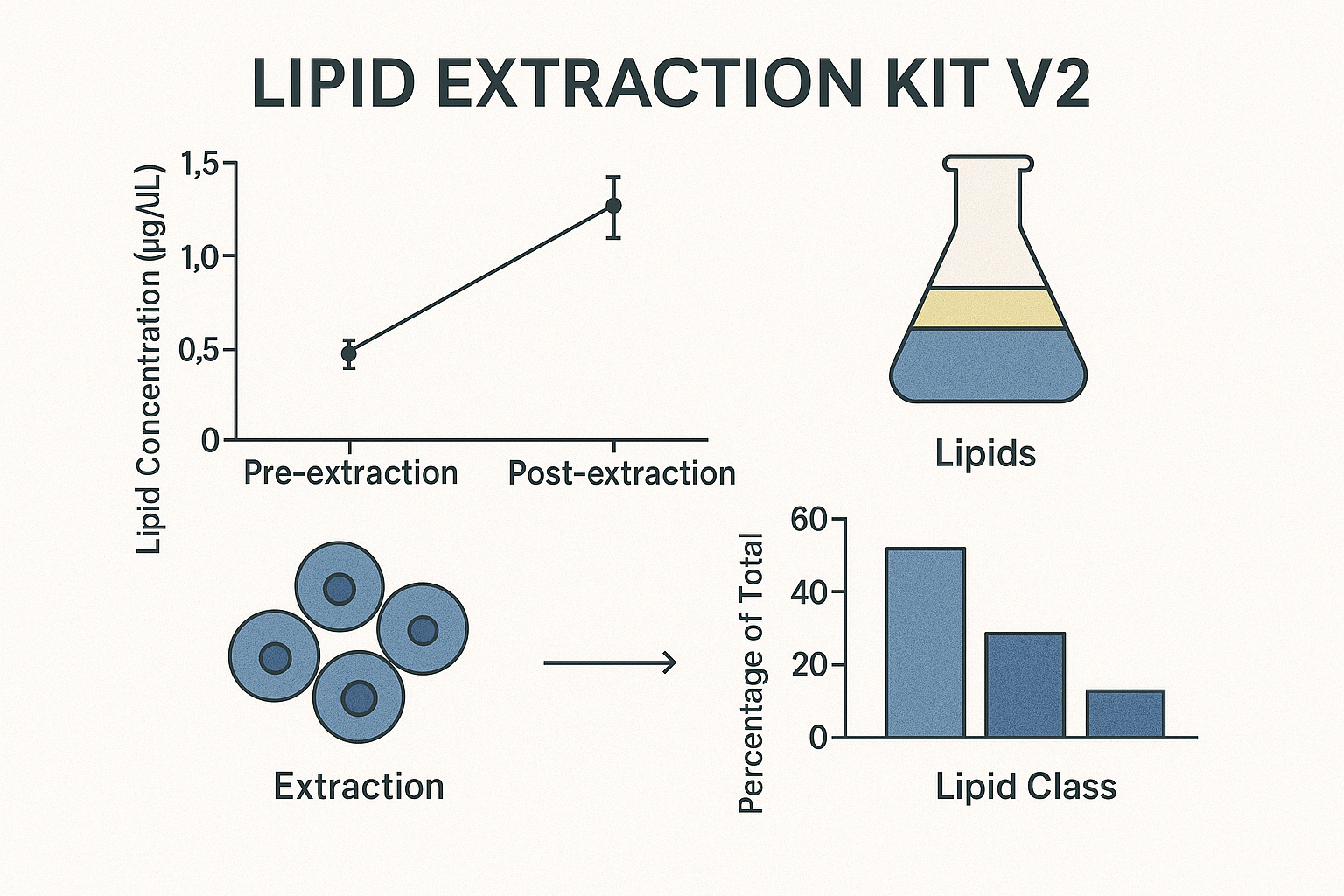
Data from University of California, San Diego (UCSD) (ucsd.edu) lipidomics core facility confirm linear correlation (R² > 0.98) between extraction yield and lipid concentration when processed using Lipid Extraction Kit V2.
Advantages Over Conventional Protocols
| Feature | Traditional Method (Bligh-Dyer) | Lipid Extraction Kit V2 |
|---|---|---|
| Solvent type | Chloroform/Methanol | MTBE/Isopropanol |
| Safety | Toxic & corrosive | Non-halogenated, safer |
| Speed | 45–60 min | 15–20 min |
| Phase clarity | Variable | Sharp, reproducible interface |
| Oxidation control | None | Includes antioxidant BHT |
| Compatibility | Manual MS calibration required | LC–MS ready extract |
Studies by Yale University (yale.edu) demonstrate that MTBE systems yield 20–30% higher recovery of polar lipids than chloroform-based extractions.
Quality Control and Validation
Each lot of the Lipid Extraction Kit V2 undergoes stringent QC testing:
-
Gravimetric lipid recovery compared to NIST standards.
-
UV–Vis absorbance at 205 nm for solvent purity.
-
MS spectral profiling using standard lipid mixtures.
-
Intra-assay CV < 5% (per FDA Bioanalytical Method Validation Guidance, fda.gov).
The Office of Laboratory Animal Welfare (OLAW) (olaw.nih.gov) ensures all preclinical lipid studies using the kit adhere to ethical and standardized analytical methods.
Safety and Environmental Compliance
The Lipid Extraction Kit V2 complies with:
-
OSHA Laboratory Standard 29 CFR 1910.1450 (osha.gov).
-
EPA Resource Conservation and Recovery Act (RCRA) for solvent disposal (epa.gov).
-
NIH Biosafety Level 1 classification (osp.od.nih.gov).
Solvent waste should be collected separately and disposed of as organic waste under EPA 40 CFR Part 261.
Troubleshooting and Optimization Tips
| Problem | Possible Cause | Recommended Solution |
|---|---|---|
| Poor lipid recovery | Incomplete homogenization | Increase vortex duration, use glass beads |
| Phase blurring | Excess aqueous content | Adjust water addition, increase centrifugation time |
| Lipid oxidation | Long extraction time | Add antioxidant or process under nitrogen |
| Solvent residue | Incomplete evaporation | Use vacuum concentrator or N₂ stream |
The University of Michigan Lipidomics Core (umich.edu) suggests using amber vials to prevent photooxidation during solvent evaporation.
Quantitative Analysis and Data Normalization
Extracted lipids can be quantified via:
-
Gravimetric weighing after evaporation.
-
Spectrophotometric measurement using sulfo-phosphovanillin reagent.
-
Internal standard normalization using deuterated lipid standards (per NIST SRM guidelines).
Normalization to total protein or cell number ensures comparability between samples, as described in National Cancer Institute (NCI) (cancer.gov) lipidomic profiling studies.
Advanced Applications
Lipid Raft Analysis
The kit enables isolation of detergent-resistant membrane domains for studying raft-associated proteins like caveolin and flotillin, key in signal transduction and pathogen entry, as outlined by NIH Cell Biology Program (cellbiology.nih.gov).
Oxidized Lipid Detection
Integrates with LC–MS workflows for detection of oxidized phospholipids implicated in atherogenesis, following CDC laboratory lipid oxidation protocols.
Exosome and Vesicle Lipidomics
The National Institute on Aging (NIA) (nia.nih.gov) emphasizes lipid profiling of extracellular vesicles to identify biomarkers for neurodegenerative diseases, which can be performed using Lipid Extraction Kit V2.
Environmental Lipidomics
Used in EPA-funded studies to quantify lipid biomarkers in soil and aquatic samples for environmental pollution assessment.
Future Innovations and Development
Emerging trends supported by NSF (nsf.gov) and DOE (energy.gov) research initiatives include:
-
Microfluidic lipid extraction chips for single-cell lipidomics.
-
Automated robotic platforms integrating Lipid Extraction Kit V2 reagents.
-
Green chemistry solvents for sustainable lipidomics.
-
AI-based spectral analysis for high-throughput lipid annotation.
Projects from the Human Biomolecular Atlas Program (HuBMAP) (hubmapconsortium.org) are already applying these kits for 3D lipid spatial mapping in human tissues.
Conclusion
The Lipid Extraction Kit V2 delivers a scientifically validated, environmentally responsible, and high-throughput solution for lipid isolation across research domains. Its MTBE-based solvent system, antioxidant protection, and optimized partitioning ensure consistent lipid recovery for LC–MS/MS, GC–MS, and fluorescent assays.
As lipidomics continues to advance in precision medicine, neurobiology, and metabolic research, tools like the Lipid Extraction Kit V2 empower laboratories to achieve reproducible, quantitative, and safe lipid profiling under standards endorsed by the NIH, FDA, EPA, and NIST.