
Amyloid ELISA Kits: Sensitive Immunoassays for Amyloid Protein Quantification in Molecular Biology Research
Introduction
In molecular biology and protein biochemistry, amyloid proteins represent an important class of peptides that form structured aggregates known as amyloid fibrils. These proteins arise from the misfolding and aggregation of specific peptide sequences and are widely studied in neuroscience, cell biology, and protein aggregation research.
One of the most widely analyzed peptides in this field is amyloid-beta (Aβ), a short peptide fragment derived from the amyloid precursor protein (APP). Amyloid-beta peptides typically range from 36 to 43 amino acids and originate through enzymatic cleavage of APP by beta- and gamma-secretases.
To measure these peptides accurately in biological samples, laboratories commonly use Amyloid ELISA Kits, which rely on antibody-based immunoassays to detect and quantify amyloid proteins with high sensitivity.
Extensive information about protein aggregation, peptide biochemistry, and molecular biology research is available through scientific institutions such as:
-
National Institutes of Health — https://www.nih.gov
-
National Center for Biotechnology Information — https://www.ncbi.nlm.nih.gov
-
National Institute of General Medical Sciences — https://www.nigms.nih.gov
-
National Human Genome Research Institute — https://www.genome.gov
-
Harvard University Department of Molecular and Cellular Biology — https://mcb.harvard.edu
These kits enable researchers to quantify amyloid peptides in serum, plasma, cell culture samples, and tissue extracts, making them valuable tools for studying protein aggregation pathways.
What Are Amyloid ELISA Kits?
Amyloid ELISA kits are laboratory immunoassay systems designed to detect and quantify amyloid peptides or aggregated amyloid proteins using enzyme-linked immunosorbent assay (ELISA) technology.
ELISA is a widely used biochemical method that detects specific proteins in liquid samples using antibodies coupled with enzyme-generated signals.
In the context of amyloid research, ELISA assays typically target:
-
Amyloid-beta 1-40 (Aβ40)
-
Amyloid-beta 1-42 (Aβ42)
-
Aggregated amyloid peptides
-
Amyloid precursor protein fragments
These assays allow precise quantification of amyloid peptides in experimental samples such as:
-
serum or plasma
-
cell culture supernatants
-
tissue homogenates
-
cerebrospinal fluid
-
purified protein extracts
For example, sandwich ELISA assays have been widely used for the quantitative measurement of Aβ peptides, offering reliable detection in biological samples.
Amyloid Proteins and Their Biological Significance
Amyloid proteins are characterized by their ability to form beta-sheet-rich fibrillar aggregates. These aggregates are composed of misfolded proteins that assemble into highly ordered structures.
The amyloid-beta peptide is one of the most extensively studied examples. It is produced from the cleavage of amyloid precursor protein (APP) and is naturally present in small amounts in the central nervous system.
Amyloid peptides can exist in multiple forms:
-
soluble monomers
-
oligomers
-
protofibrils
-
mature fibrils
Understanding how these forms arise and interact is a central topic in protein aggregation research.
Educational resources discussing protein aggregation and peptide biochemistry include:
-
Stanford University Department of Genetics — https://med.stanford.edu/genetics.html
-
MIT Biology Department — https://biology.mit.edu
-
University of California molecular biology programs — https://biology.ucsd.edu
-
Cold Spring Harbor Laboratory — https://www.cshl.edu
Principle of the Amyloid ELISA Assay
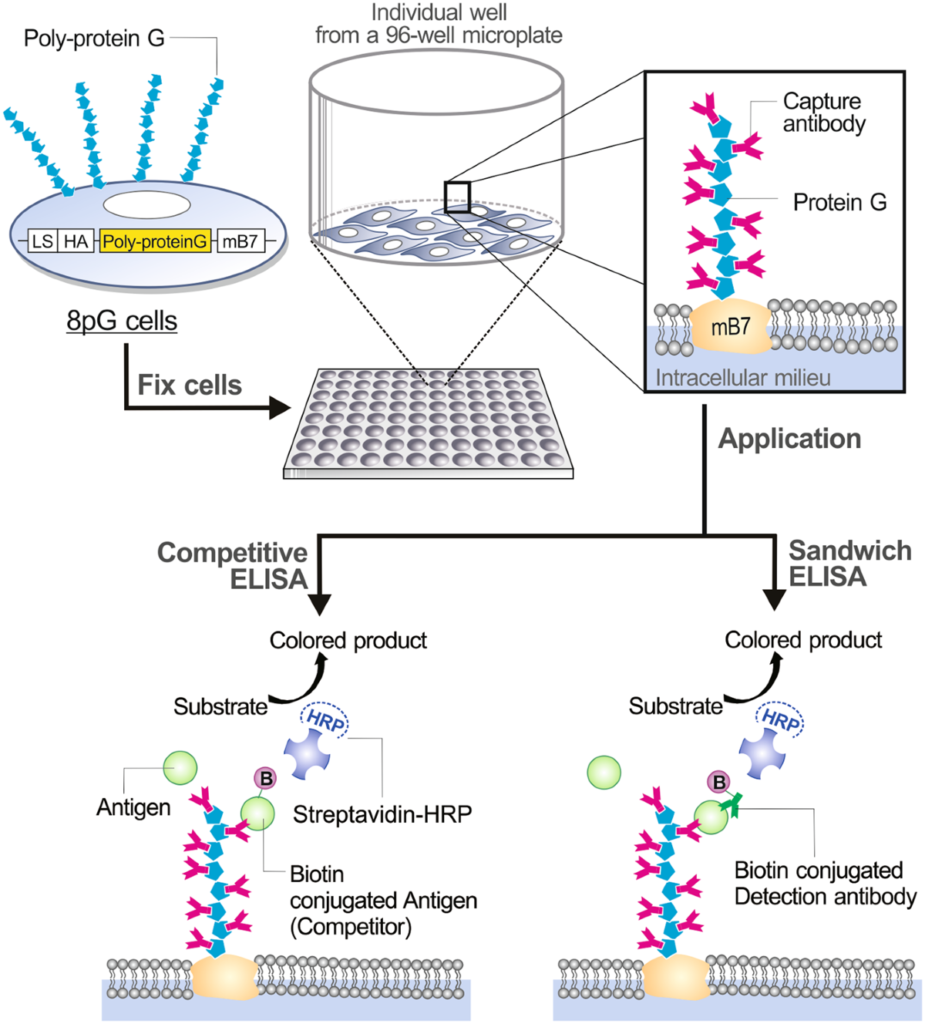
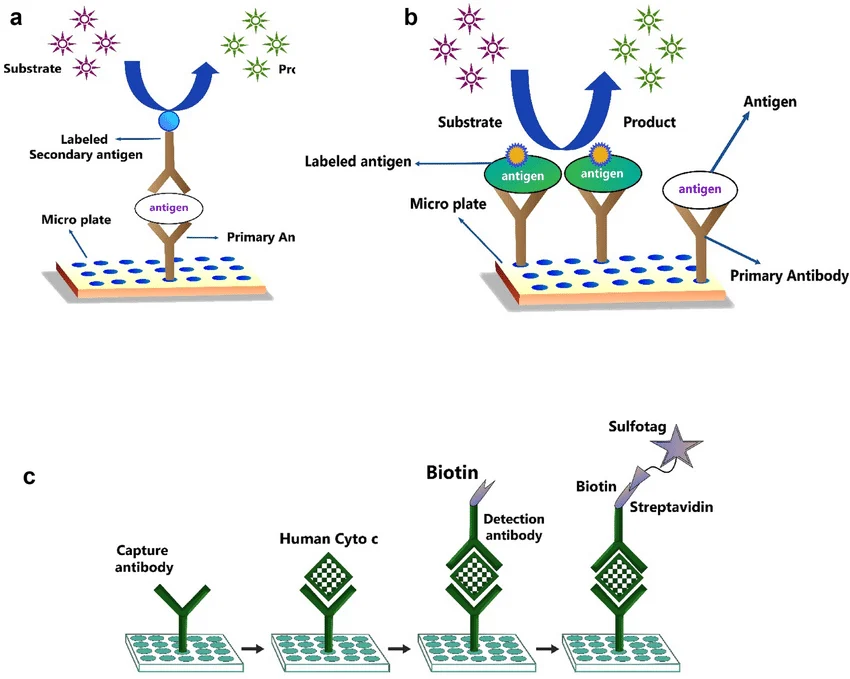
Most Amyloid ELISA kits operate using the sandwich ELISA principle, which relies on two antibodies recognizing different regions of the amyloid peptide.
The typical assay procedure includes:
-
Capture antibodies coated onto microplate wells bind amyloid peptides present in the sample.
-
A biotinylated detection antibody binds the captured amyloid protein.
-
An enzyme-conjugated reagent (often HRP) generates a measurable signal.
-
Addition of a chromogenic substrate produces a color change.
-
Absorbance is measured at 450 nm using a microplate reader.
The intensity of the color signal is proportional to the concentration of amyloid peptide present in the sample.
This approach allows sensitive measurement of amyloid peptides with detection ranges typically in the picogram per milliliter range.
Types of Amyloid ELISA Kits
Several types of ELISA assays are commonly used in amyloid research.
1. Amyloid-Beta 1-40 ELISA Kits
These assays detect the Aβ1-40 peptide, one of the most abundant amyloid fragments produced from APP cleavage.
Sandwich ELISA assays targeting Aβ1-40 can quantify peptide concentrations in biological samples such as cell culture supernatants, tissue lysates, and cerebrospinal fluid.
2. Amyloid-Beta 1-42 ELISA Kits
Aβ1-42 is a slightly longer peptide variant that is highly studied in protein aggregation research.
Many ELISA kits are designed to quantify Aβ1-42 in serum, plasma, tissue homogenates, or cell culture samples, using high-sensitivity antibody pairs.
3. Aggregated Amyloid Detection Kits
Some assays specifically detect aggregated or oligomeric amyloid species, which are important intermediates in protein aggregation processes.
These assays rely on antibodies recognizing conformational epitopes present in aggregated forms of the protein.
Biological Samples Compatible with Amyloid ELISA Kits
Amyloid ELISA kits can analyze multiple biological sample types.
Typical samples include:
• serum
• plasma
• cerebrospinal fluid
• cell culture supernatants
• tissue lysates
• brain tissue extracts
• purified protein samples
Because ELISA assays require relatively small sample volumes, they are widely used for routine laboratory analysis of amyloid peptides.
Research Applications of Amyloid ELISA Kits
Amyloid ELISA assays are used across several scientific research fields.
1. Protein Aggregation Research
Understanding the mechanisms of protein folding and aggregation is a major area of molecular biology research.
Amyloid ELISA assays allow scientists to quantify amyloid peptides during aggregation experiments.
Studies of peptide aggregation mechanisms help researchers analyze:
-
nucleation processes
-
fibril formation
-
oligomerization dynamics
-
protein stability
2. Neuroscience Research Models
Amyloid peptides are frequently investigated in neuroscience research models because of their role in neuronal protein aggregation pathways.
Researchers often analyze amyloid peptides in brain tissue extracts or cell culture systems to study protein accumulation and aggregation.
Academic neuroscience programs exploring amyloid biology include:
-
Johns Hopkins Neuroscience — https://neuroscience.jhu.edu
-
Stanford Neuroscience Institute — https://neuroscience.stanford.edu
-
Harvard Brain Science Initiative — https://brain.harvard.edu
3. Drug Discovery and Protein Interaction Studies
Amyloid ELISA assays are also used in screening experiments to evaluate compounds that interact with amyloid peptides or influence protein aggregation.
Such experiments may involve:
-
peptide aggregation assays
-
antibody screening
-
inhibitor screening
-
structural biology research
Research programs studying protein misfolding and aggregation can be explored through:
-
National Institute of Neurological Disorders and Stroke — https://www.ninds.nih.gov
-
National Institutes of Health protein research programs — https://www.nih.gov
-
University of Cambridge protein folding research — https://www.bioc.cam.ac.uk
Advantages of Amyloid ELISA Kits
Amyloid ELISA assays provide several technical advantages.
High Sensitivity
Antibody-based detection enables measurement of extremely low peptide concentrations.
Quantitative Results
Standard curves allow precise quantification of amyloid peptide levels.
High Throughput
Microplate formats enable simultaneous analysis of multiple samples.
Reproducibility
Validated antibodies and optimized reagents support consistent assay performance.
Compatibility with Multiple Sample Types
ELISA assays work with biological fluids, cell culture samples, and tissue extracts.
Typical Workflow of an Amyloid ELISA Experiment
A standard amyloid ELISA workflow typically includes:
-
Preparation of standards and samples
-
Addition of samples to antibody-coated microplate wells
-
Incubation with detection antibodies
-
Washing steps to remove unbound components
-
Addition of enzyme-conjugated reagents
-
Substrate reaction for color development
-
Measurement of absorbance using a microplate reader
-
Data analysis using a standard calibration curve
This workflow allows reliable quantification of amyloid peptides within a few hours.
Integration With Other Molecular Biology Techniques
In many laboratories, amyloid ELISA assays are combined with other analytical techniques to obtain more comprehensive data.
Examples include:
• Western blot analysis
• mass spectrometry
• fluorescence aggregation assays
• electron microscopy
• immunohistochemistry
Combining these techniques allows researchers to analyze amyloid protein structure, aggregation dynamics, and molecular interactions.
Conclusion
Amyloid ELISA Kits are essential tools for detecting and quantifying amyloid peptides in molecular biology and protein aggregation research.
By using antibody-based immunoassays, these kits enable sensitive measurement of amyloid-beta peptides and aggregated amyloid proteins in biological samples.
Their high sensitivity, reproducibility, and compatibility with diverse sample types make them valuable analytical tools in studies of protein aggregation, peptide biochemistry, and molecular biology.
As research on protein folding and aggregation continues to evolve, ELISA-based detection systems remain fundamental technologies for analyzing amyloid peptides and related molecular processes.