
Streptavidin Magnetic Beads: Principles, Mechanisms, and Applications in Biotin-Based Molecular Purification
Introduction
Streptavidin Magnetic Beads represent one of the most widely used tools in molecular biology, proteomics, and immunodiagnostics, exploiting the extraordinarily strong biotin–streptavidin interaction for biomolecule capture and purification.
The streptavidin–biotin bond, with a dissociation constant of ~10⁻¹⁵ M, is among the strongest non-covalent interactions known in nature (National Center for Biotechnology Information – NCBI). When immobilized on superparamagnetic beads, streptavidin enables efficient, specific, and reproducible isolation of biotinylated DNA, RNA, proteins, peptides, or antibodies using a magnetic field, eliminating the need for centrifugation or filtration.
This method is now foundational in next-generation sequencing (NGS) workflows, ChIP-seq, RT-PCR sample prep, target enrichment, and immunoprecipitation assays, as validated by multiple NIH, FDA, and NIST research protocols.
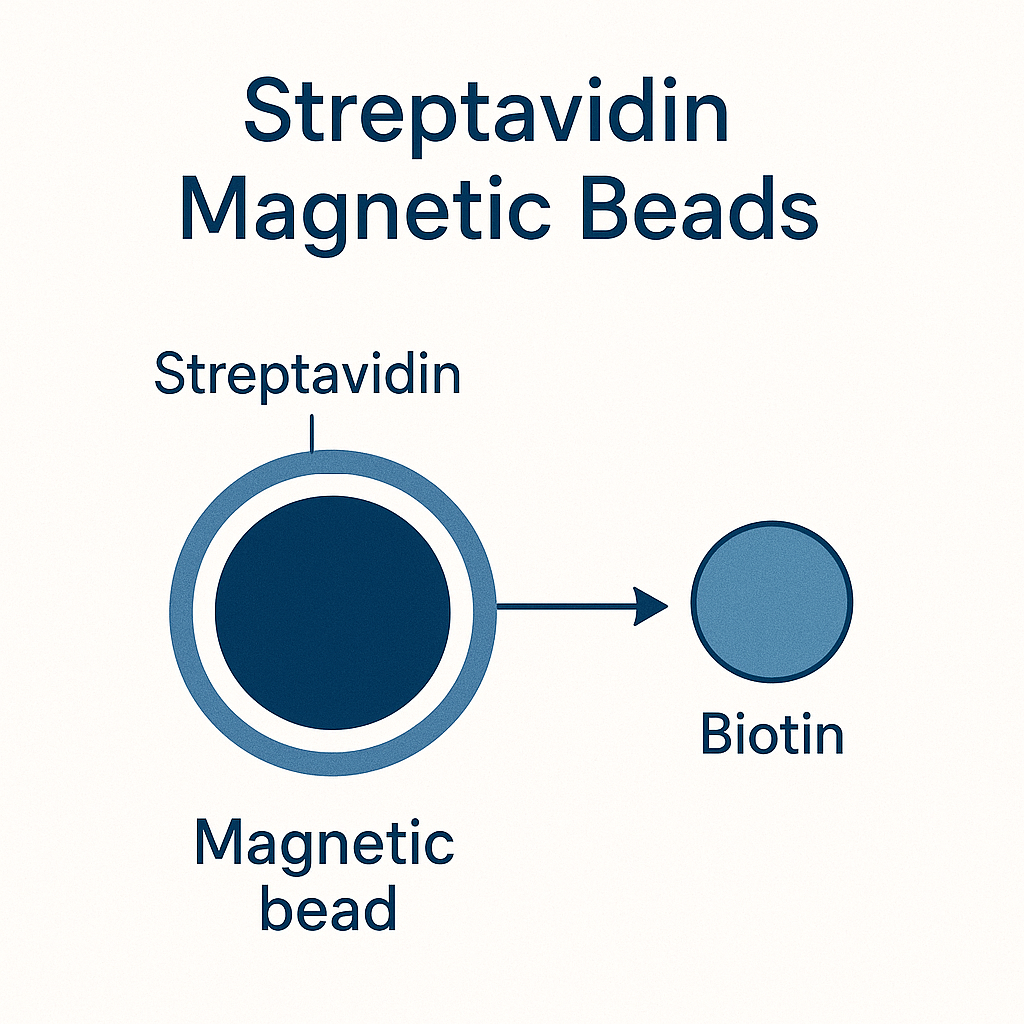
Molecular Mechanism of Streptavidin–Biotin Binding
Streptavidin is a tetrameric protein (≈60 kDa) originally derived from Streptomyces avidinii. Each monomer can bind one molecule of biotin (vitamin B7) with extremely high affinity and stability.
The tight binding arises from hydrogen bonding, van der Waals interactions, and hydrophobic forces between streptavidin and biotin’s ureido ring (PubChem – NIH).
Structural analyses using X-ray crystallography (Protein Data Bank – PDB) show that the biotin molecule is deeply buried within a binding pocket of streptavidin, protected from solvent exposure, which contributes to its resistance to extreme pH, temperature, and denaturants.
This unparalleled binding stability allows biotin–streptavidin systems to remain functional even after repeated washing or exposure to detergents like SDS or Tween-20, as detailed by the National Institutes of Health (NIH).
Composition and Surface Chemistry of Magnetic Beads
Modern streptavidin magnetic beads are typically composed of an iron oxide (Fe₃O₄ or γ-Fe₂O₃) core, encapsulated within a polymer matrix such as dextran, silica, or polystyrene, which is then functionalized with streptavidin molecules on the surface.
According to NIST’s nanomaterials characterization guidelines, optimal bead design must ensure:
-
High streptavidin density
-
Uniform particle size distribution (0.5–2.8 µm diameter)
-
Low non-specific binding
-
Chemical stability in buffers, serum, and organic solvents
These parameters guarantee efficient biomolecule capture with minimal loss, making streptavidin beads a gold standard for affinity purification and biotinylated molecule isolation.
Principle of Magnetic Separation
The core concept behind magnetic bead technology lies in superparamagnetism — the property that magnetic nanoparticles exhibit strong magnetization in an external field but lose magnetization once the field is removed (National High Magnetic Field Laboratory – Florida State University).
When exposed to a magnetic field, streptavidin-coated beads aggregate on the side of a microtube, allowing the supernatant to be easily removed. When the magnet is removed, the beads redisperse homogeneously, enabling multiple wash steps.
This process enables highly specific capture–wash–elute workflows ideal for biotinylated nucleic acid and protein purification (NCBI – Magnetic Bead–Based Isolation Methods).
Biotinylation and Sample Preparation
To use streptavidin beads, target molecules must first be biotinylated via chemical or enzymatic conjugation:
-
Proteins → Labeled using NHS-biotin or maleimide-biotin reagents
-
Nucleic acids → Modified during PCR or transcription using biotin-dUTP
-
Antibodies → Biotinylated on lysine residues using biotin-NHS ester
Detailed conjugation procedures are described in the NIH Bioconjugation Handbook.
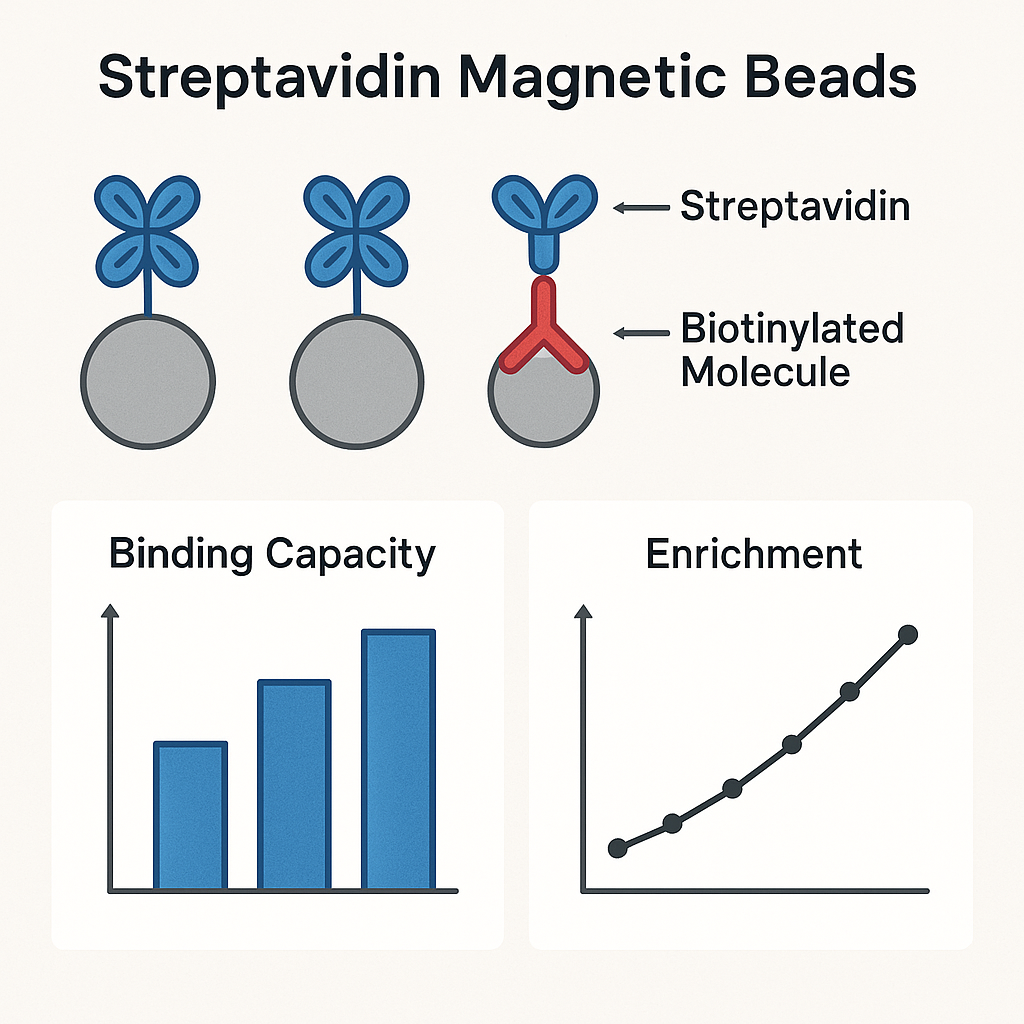
After labeling, the biotinylated molecule is incubated with streptavidin magnetic beads, forming stable complexes ready for isolation.
Applications in Life Sciences and Biotechnology
DNA and RNA Purification
Streptavidin magnetic beads are a cornerstone in nucleic acid extraction and hybridization capture workflows, particularly in NGS library preparation and RNA pulldown assays.
The National Human Genome Research Institute (NHGRI) highlights their use in targeted sequencing and mRNA enrichment via biotinylated probes.
Immunoassays and ELISA
In sandwich ELISA formats, biotinylated capture antibodies immobilized via streptavidin beads yield high signal-to-noise ratios and stable immobilization (FDA ELISA Standards).
This system is used widely in clinical diagnostic kits for hormones, cytokines, and infectious diseases under ISO 13485 regulatory frameworks.
Protein–Protein Interaction Studies
Streptavidin beads enable efficient immunoprecipitation and protein–protein interaction mapping, particularly in proteomics pipelines.
The National Cancer Institute (NCI) recommends streptavidin pulldown as a reference technique for identifying binding partners in post-translational modification research.
Enzyme and Antibody Immobilization
Due to their strong and stable binding, streptavidin-coated beads are ideal for immobilizing biotinylated enzymes or antibodies for use in biosensors, flow reactors, and point-of-care diagnostics (NIST Bioprocess Measurement Group).
Exosome and Vesicle Isolation
Recent studies have demonstrated that streptavidin–biotin affinity systems can be applied to the purification of biotin-labeled exosomes for downstream RNA or protein profiling (PubMed Central).
Workflow Overview
A general streptavidin magnetic bead protocol follows these steps:
-
Equilibrate beads in binding buffer.
-
Add biotinylated sample (DNA, RNA, protein, or antibody).
-
Incubate with gentle mixing to allow binding.
-
Apply magnet to collect bead–biomolecule complexes.
-
Wash repeatedly to remove nonspecific contaminants.
-
Elute under denaturing or competitive conditions (using free biotin or heat).
Optimized buffer conditions are provided in NIH’s Standard Protocol for Magnetic Bead Purification.
Regeneration and Reuse
Although the streptavidin–biotin bond is extremely stable, regeneration typically involves competitive elution with excess biotin or harsh denaturation (e.g., 8 M guanidinium hydrochloride).
The U.S. National Library of Medicine (PubChem) provides detailed chemical stability data. However, because this treatment can inactivate streptavidin, most applications rely on single-use beads for reproducibility and purity.
Comparison with Avidin-Based Systems
| Property | Streptavidin | Avidin (from egg white) |
|---|---|---|
| Glycosylation | None (non-glycosylated) | Highly glycosylated |
| Isoelectric Point (pI) | ~6.0 | ~10.5 |
| Non-Specific Binding | Low | High |
| Solubility | High | Moderate |
| Recommended for | Molecular biology assays | Immunohistochemistry |
The absence of carbohydrate residues in streptavidin minimizes nonspecific interactions, improving accuracy in immunoassays and molecular purifications, as confirmed by NIH Protein Structure Resources.
Storage and Handling
According to NIAID guidelines, streptavidin magnetic beads should be stored at 4°C in PBS or Tris buffer containing 0.02% sodium azide.
Avoid freezing, as it can alter the magnetic core structure and streptavidin activity. Beads remain stable for over 24 months under proper conditions.
Advantages and Limitations
| Advantages | Limitations |
|---|---|
| Ultra-high affinity for biotin | Single-use nature due to irreversible binding |
| Fast and clean magnetic separation | Requires biotinylation of target |
| Compatible with many assay formats | Streptavidin denaturation under strong denaturants |
| Low background noise | Cost higher than non-functionalized beads |
| No need for centrifugation | Requires magnet setup |
Protocols for performance validation can be referenced from the FDA Center for Devices and Radiological Health and NIH Biotech Methods.
Advanced Applications in Genomics and Proteomics
-
Next-Generation Sequencing (NGS): Used for fragment capture and adapter purification in Illumina and Oxford Nanopore workflows (NHGRI).
-
Chromatin Immunoprecipitation (ChIP-seq): Biotinylated chromatin fragments pulled down by streptavidin beads for epigenetic mapping (PubMed – NIH).
-
Protein Biomarker Discovery: Capturing biotinylated proteins in plasma for mass spectrometry analysis (NIST Proteomics Standards).
Safety and Regulatory Considerations
Streptavidin magnetic beads are classified as non-hazardous materials but must comply with biosafety level 1 (BSL-1) guidelines during handling.
Follow safety protocols defined by the Centers for Disease Control and Prevention (CDC) and Occupational Safety and Health Administration (OSHA).
Disposal should follow EPA environmental safety recommendations for iron oxide–based nanomaterials (EPA Nanotechnology Research).
Future Perspectives
Emerging directions in streptavidin bead technology include:
-
Site-specific streptavidin mutants with altered biotin affinity for reversible binding (NIH Structural Biology Program).
-
Nanobead miniaturization for single-cell isolation and microfluidic platforms.
-
AI-optimized bead design for automated high-throughput diagnostics.
-
Magnetoplasmonic hybrid beads combining optical and magnetic detection for biosensors (NIST Nanoscience Group).
These developments will expand streptavidin bead use beyond laboratory purification into clinical-grade diagnostics, point-of-care testing, and bioengineering.
Conclusion
Streptavidin Magnetic Beads remain one of the most versatile and powerful affinity tools in biotechnology.
Their exceptional binding affinity, chemical stability, and ease of magnetic manipulation make them indispensable in molecular biology, clinical diagnostics, proteomics, and genomics.
From DNA/RNA purification to immunoassay signal enhancement, the streptavidin–biotin system continues to define precision, reproducibility, and efficiency in research laboratories worldwide.
As next-generation materials and recombinant engineering advance, streptavidin magnetic beads will remain central to innovations in bioseparation, nanobiotechnology, and molecular diagnostics.B